
How to Check Criminal History in Jacksonville
Begin with the office that made the record. Jacksonville Police Department reports stay with the city. The Morgan County Sheriff holds county jail and current-custody information, while the Morgan County Circuit Clerk keeps filed felony, misdemeanor, and traffic cases. Illinois State Police maintains the statewide criminal-history repository. Those sources answer different questions. A police narrative records an alleged event, a booking confirms custody, and a court disposition records the outcome of a prosecution.
A focused five-step check avoids asking one office for material held elsewhere:
- Identify whether Jacksonville Police or another agency handled the event.
- Request the city incident or arrest report through Jacksonville's FOIA channel.
- Ask the sheriff about a booking or current county-jail custody.
- Search Judici or contact the Morgan County Circuit Clerk for a filed case.
- Use ISP Access and Review to inspect your own fingerprint-based Illinois record.
Have lawful identifiers ready, such as a report number, date, location, booking date, or court case number. A name alone can produce poor matches. For broader county routing, the Morgan County criminal history overview explains how the local layers connect.
Jacksonville Criminal Cases Take Two Paths
Jacksonville's “Municipal Court” is an administrative-adjudication department. It handles specified city ordinance matters. It is not a separate Illinois criminal trial court. Property-maintenance, building, residential and fire-code violations may appear there, along with parking and non-moving vehicle matters. The city's published jurisdiction also includes weeds, prohibited vehicle storage, trash accumulation, open burning, curfew, fireworks, disturbing the peace, and certain disorderly-conduct matters.
State criminal charges take the other path. Felonies and misdemeanors arising from a Jacksonville arrest are filed in the Circuit Court, where the Morgan County Circuit Clerk maintains the docket and documents. This distinction matters because a search of one path does not search the other. A city ordinance file cannot substitute for the circuit disposition, and Judici does not serve as Jacksonville's administrative docket.
The Jacksonville Police Department
Jacksonville Police creates and retains its own incident and arrest reports. The official police webspace is the first agency reference, but the city's most useful public-record route is the City Clerk's FOIA hub. The clerk links an online request form and annual disclosure logs. Those logs show that people have requested police reports, arrest records, wellness checks, call records, crash material, and incident-number reports. They demonstrate the request route, not that every requested item was released in full.
The official Jacksonville Police Department page provides the city police starting point.
When the police page is unavailable, use the clerk's online FOIA form or the municipal-building counter. If another agency handled the incident, send the request to that agency instead.
Request Jacksonville Police Records Online
The Jacksonville City Clerk describes the office as a link between residents and municipal government and expressly provides public-record services. Its online FOIA form asks for requester contact details, whether the request is for a commercial purpose, a description of the records, and the preferred response method. A useful description names Jacksonville Police, gives the incident or report number if known, states an approximate date and location, and identifies the exact material sought.
The Jacksonville City Clerk FOIA hub is the documented online entry point.
Ask for an electronic response when suitable and retain the confirmation. Annual request logs do not waive privacy rules. Juvenile information, victim details, open-investigation material, and private identifiers may be withheld or redacted under Illinois law.
Arrests and Bookings in Jacksonville
Jacksonville does not advertise a city jail or city inmate roster. After a custodial arrest, the practical route moves from the Jacksonville police report to Morgan County jail channels. The city report may describe the event and initial allegations. The sheriff can address booking or current custody. If prosecutors file charges, the Circuit Clerk's case becomes the source for court events and final disposition.
These records can disagree without any office being wrong. Charges listed at intake may change after review. A prosecutor may decline a count, amend the charging document, or file a different offense. A booking proves that custody occurred, not guilt. Morgan County has no published public online jail roster, so callers should use the sheriff's official phone, counter, or FOIA channel. The county-wide arrest history page gives the fuller custody fallback chain.
One Jacksonville Arrest, Three Records
A local arrest can create three distinct records. Jacksonville Police produces the incident or arrest report. Morgan County creates a jail booking if the person enters county custody. The Circuit Clerk opens a court file only when a charge is filed. Later, reportable arrest fingerprints and the court outcome can flow to the ISP Bureau of Identification.
Use each source for its own purpose. The police record best answers what officers reported. The booking record answers when custody began and ended. The court file answers which charges were filed and how the judge resolved them. A public UCIA response from ISP is narrower because Illinois permits public dissemination of conviction information, not every arrest allegation. People reviewing their own full Illinois history should use fingerprint-based Access and Review through a licensed live-scan vendor.
Jacksonville Municipal Court Records
The city administrative-adjudication system offers a hearing process for ordinance cases. Respondents may have counsel, present witnesses, and cross-examine opposing witnesses. Its landing page links information about initial appearances, court dates, payment options, the hearing officer, and the assistant city attorney. It does not provide a public name or case-number search box, so use the municipal counter or phone and request releasable records through city FOIA.
| Court Name | Jacksonville Municipal Court, an administrative-adjudication department |
|---|---|
| Case Types Heard | Listed property, code, parking, non-moving vehicle, nuisance, curfew, fireworks, and other ordinance matters |
| Case Lookup Channel | Municipal counter or phone; written city FOIA request for releasable records |
| What the Docket Shows | City citation, hearing, finding, order, or payment information maintained in the administrative system |
| Copies & Fees | Ask the city for the current copy method and any applicable charge; no public search fee is stated on the landing page |
Inside Jacksonville Ordinance Records
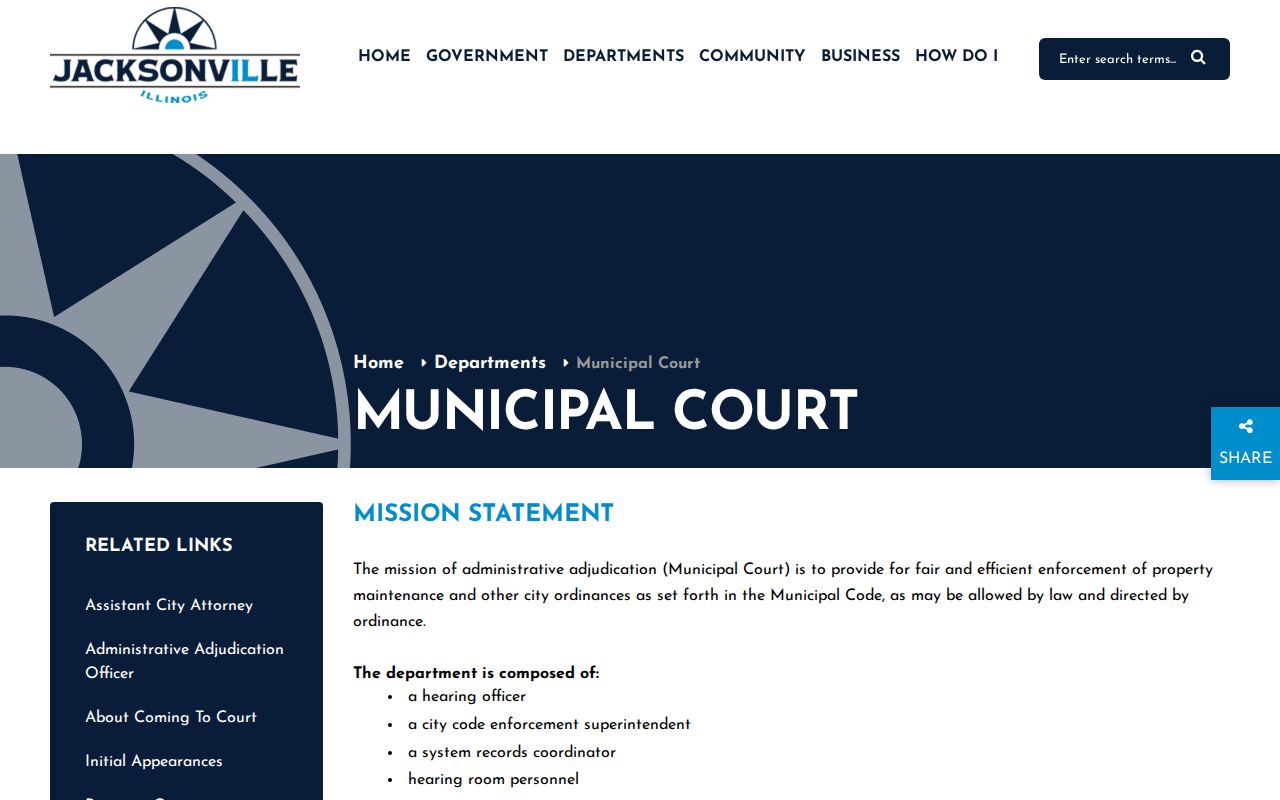
The city's published jurisdiction list makes its administrative record unusually concrete. A municipal file may concern tall weeds, unsafe property, a parking infraction, trash, open burning, fireworks, curfew, or discharging a bow or firearm inside city limits. The label “Municipal Court” can sound like a criminal court, but the city's mission centers on fair and efficient ordinance enforcement.
The official Jacksonville Municipal Court page sets out that jurisdiction and respondent rights.
If a citation is unclear, ask the municipal office which system holds it. For a state-law criminal or traffic filing, move to the Morgan County Circuit Clerk rather than assuming City Hall has the court record.
Where Jacksonville Records End Up
Jacksonville remains the holder of reports created by its police officers. County offices take over different parts after custody or prosecution. The sheriff records a county-jail booking, and the Circuit Clerk maintains a filed court case. Reportable arrest events and court dispositions are sent to ISP so BOI can associate them with the correct state record.
Record flow: Jacksonville Police Department › Morgan County Circuit Court › Illinois State Police Bureau of Identification
Recent activity may appear first at the city or county level. An older, completed case should be checked against the circuit disposition and, for self-review, the fingerprint-based state response. Reporting delay or an unmatched disposition can leave the layers out of sync. Obtain a certified local disposition if an ISP record appears incomplete, then follow the Record Challenge instructions included with Access and Review results.
Read Jacksonville Crime Data Carefully
Jacksonville's city and police sites do not publish a current local crime dashboard or annual statistical report. That absence should not be filled with an unsupported number. The Illinois State Police publishes Crime in Illinois annual reports with agency tables. Searchers must cite the Jacksonville Police Department row together with the selected reporting year. The FBI Crime Data Explorer offers a second official comparison source, but its coverage and reporting-status flags must stay with any value.
City data should not be mixed with Morgan County totals. Jacksonville is the county seat and largest population center, but a county total can include sheriff activity and reports from other municipalities. Likewise, a count of reported offenses is not the same as arrests, filed court cases, or convictions. Each measure describes a different stage of the justice process.
Before comparing two years, confirm that Jacksonville Police reported through the same program and that the displayed offense definitions match. A partial-year figure or an agency with a coverage warning cannot support a fair trend claim. The source year, agency name, measure, and reporting note belong beside any statistic. This keeps a public-data check tied to the city without turning a reported-offense table into a claim about individual Jacksonville residents.
Jacksonville Records Span Nearby Offices
Jacksonville was laid out in 1825 and developed as an educational and institutional center. Its historic downtown square, Governor Duncan Mansion, Underground Railroad sites, and federally documented historic district give the city a strong local identity. The record geography is also compact. City Hall and municipal adjudication remain city functions, while the Morgan County Courthouse in Jacksonville holds the circuit-court layer.
Do not let proximity blur custody. Jacksonville municipal offices are not the Morgan County Circuit Clerk, and neither is the sheriff. The courthouse is at 300 West State Street. Jacksonville's municipal government operates at 200 West Douglas Avenue. Confirm the correct counter before visiting, especially when seeking older paper material or when construction may affect access.
Public Access Rules for Jacksonville Records
Illinois FOIA applies to releasable city police and administrative records, but it does not make every detail public. Agencies may redact private information and protect juvenile, victim, active-investigation, and law-enforcement-sensitive material. Court access follows judicial rules as well as statutes; ordinary agency FOIA is not a substitute for requesting a court file from the Circuit Clerk. Sealed, expunged, juvenile, and impounded matters will not behave like open records.
Key Statutes:
Illinois Freedom of Information Act, 5 ILCS 140 - creates a right to inspect public agency records subject to stated exemptions.
20 ILCS 2635, Uniform Conviction Information Act - limits public ISP dissemination to conviction information.
20 ILCS 2630/5.2 - governs Illinois expungement and sealing eligibility and procedures.
Search results should be verified with the originating office. Never treat a report, booking, or name match as proof of guilt.